The Architecture of Attention · plate I
The science behind the shape.
We make a claim most paper does not: that the shape of a page can change how clearly you think. This is where we back it up.
Every design choice in a Quire planner traces to a principle from cognitive science, grouped the way we think about it internally, as six layers of attention. Each carries an honest note on what the research does and does not show.
We cite it, or we label it a hypothesis. We would rather under-claim and be trusted than become another wellness brand with a footnote nobody checks.
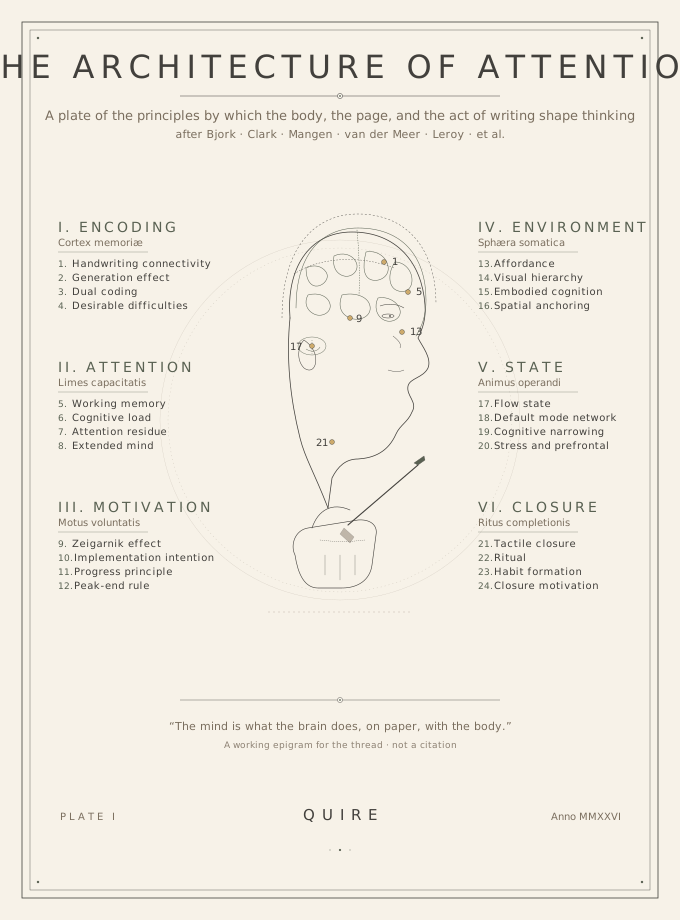
Plate I · after Bjork · Clark · Mangen · van der Meer · Leroy · et al.
Encoding
Cortex memoriæHow information enters and stays.
1. Handwriting connectivity · 2. Generation effect · 3. Dual coding · 4. Desirable difficulties
Writing by hand is a richer act than tapping keys, and there is reason to think it helps you hold onto what you write. The evidence is mixed. The headline handwriting study has been formally challenged, and we say so. The sturdier pattern is the generation effect: you remember what you produce yourself far better than what you copy. A planner you fill in beats a feed you scroll.
Handwriting claim · on hold, paired with its rebuttalAttention
Limes capacitatisWhat the brain does with finite capacity.
5. Working memory · 6. Cognitive load · 7. Attention residue · 8. Extended mind
Working memory is small. It holds a handful of things at once, not the forty on your list. A page that respects that ceiling gives your attention somewhere to rest instead of somewhere to drown. Paper, on this view, is not a worse screen. It is part of how you think, an extended mind you can hold in your hand.
Extended mind · a lens, not proofMotivation
Motus voluntatisWhy you start and why you finish.
9. Zeigarnik effect · 10. Implementation intentions · 11. Progress principle · 12. Peak-end rule
Two quiet mechanisms do most of the work. Small wins build momentum, which is why the easy tasks earn their place rather than being filler. And unfinished tasks nag until they are closed, the Zeigarnik effect, which most apps exploit to keep you hooked. We use it the other way, to help you close the loop and put the day down.
Sources · Amabile & Kramer 2011 · Zeigarnik 1927Environment
Sphæra somaticaHow form and space shape behaviour.
13. Affordance · 14. Visual hierarchy · 15. Embodied cognition · 16. Spatial anchoring
A tool you can see is a tool you use, so the planner is a long strip that lives on the desk in your eyeline, not a book that shuts in a drawer. Paper also gives a memory a physical place, which a scrolling screen cannot. Where something sat helps you recall it.
Source · Umejima et al. 2021State
Animus operandiThe mode you are in while thinking.
17. Flow · 18. Default mode network · 19. Cognitive narrowing · 20. Stress and the prefrontal cortex
Good work happens in an uninterrupted block, the state Csikszentmihalyi called flow. The planner protects one such block a day rather than scattering your attention across a dozen open things. Stress narrows attention, so you think worse exactly when you feel busiest. Do less, clearly, beats push harder.
Calmer planner helps · our reasoning, kept apart from the neuroscienceClosure
Ritus completionisWhy physical objects close cognitive loops.
21. Tactile closure · 22. Ritual · 23. Habit formation · 24. Closure motivation
Tearing the day off is a small, deliberate ending. It signals to your brain that the loop is closed, in a way ticking a box never quite manages. The week gets physically shorter as you go, and so does the load you carry. No direct study shows tearing beats ticking. This is a reasoned design claim, and we present it as exactly that.
Tactile closure · labelled hypothesisWhat this isn't
Paper does not make you smarter.
A planner fixes nothing on its own. The honest version is the only one worth printing: good tools lower the cost of thinking clearly. The rest is you.